2024 handed me the most beautiful, disorienting plot twist of my life — motherhood. And “180 degree turn” barely scratches the surface of what that truly means. It isn’t just the sleepless nights or the new rhythm your body is forced to learn. It’s the quiet, almost violent shift in who you are. My priorities, my fears, my definition of strength, even the way I measure a good day changed.
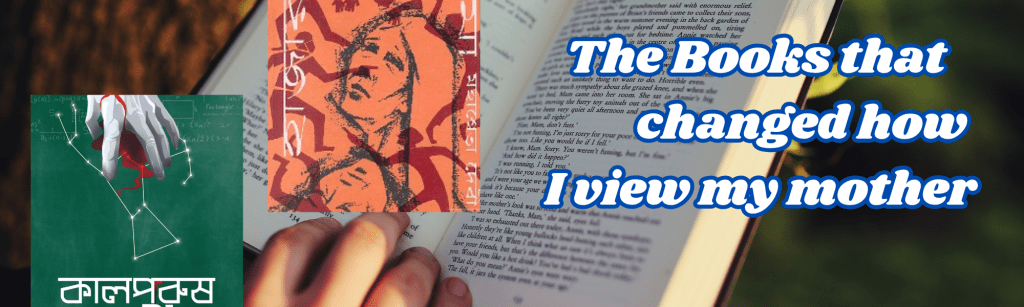
Not long ago, I stumbled upon 2 books – Hajar Churasir Maa and Kalpurush. These two narratives explore the archetype of the “all-sacrificing mother” who acts as the sole emotional anchor in a world of family betrayal and political chaos.
In Mother of 1084 ( Hajar Churasir Maa) , we meet Sujata, a mother living in a wealthy yet morally hollow household where her son Brati’s revolutionary spirit is treated as a stain to be erased. Sujata endures a marriage where her husband justifies his own infidelity and traditional dominance—a hostile dynamic the other children normalize, but one that only Sujata and Brati truly see through. to earn enough, to do enough, to one day pull Sujata away from the suffocating fog of domestic chaos that she had silently endured for years. He wanted to rescue her. However Fate smiled cruelly. A hand extended to innocent friends turns his life upside down. Overnight, Brati ceased to exist as a son. He became a number — 1084. Cold, administrative, stripped of identity. The state reduced an entire human being, with his depth and devotion and dreams, to a Naxalite on a list. The delusional family retreats and quietly buries the truth under the unbearable weight of social fear -Ostracization. So they choose denial over dignity — Brati’s memory sacrificed at the altar of respectability. This is the crux where Sujata refuses to submit and so begins a mother’s relentless, heartbreaking pursuit — not for justice in any grand political sense, but simply for truth. “Who was Brati to you?” She chases every person who ever truly knew Brati. Every friend, every shadow, every quiet corner of his emotional world that she was perhaps never invited into while he lived. She is piecing her son back together, one conversation at a time — reclaiming Brati from the number they buried him under. A mother reclaims her deceased son over fragments of memories. Mahasweta Devi’s writing doesn’t dramatize pain — she simply places it in front of you, unflinching.
In Kalbela, Madhabilata stands as the pillar of strength for her son, Arka, insulating him from the wreckage of his father’s past and the harsh realities of their environment. Madhabilata carries her world alone. No anchor from a husband, no cushion of support — just the quiet, dignified grind of a woman who works, sustains, and persists so that Arka can have a life softer than her own. She doesn’t martyr herself loudly. She simply shows up, every single day, in that deeply recognizable way that mothers do — invisibly holding everything together while the world looks elsewhere. Arka, young and still finding the edges of himself, carries a certain restlessness that only a missing father can carve into a child. It is fulfilled when a chance visit to his father’s ancestral home shifts something fundamental inside him. Quietly, almost imperceptibly, he begins to change — finding a thread back to his own roots. The ancestral home doesn’t give him a father, but it gives him something equally precious — context and a sense of belonging. And perhaps that is what Madhabilata always silently worked towards – to find a better life for Arka. Madhabilota as a mother excels better than Madhabilota as a wife.
Both stories examine how a mother’s love creates a sanctuary of order amidst a sea of societal and domestic “chao.” Motherhood is the most fierce and tender act of love.
Read more about the books I have read so far
You can also reach me on Facebook or Instagram to share your views.
 Ordo Ab Chao
Leave a comment